
English ![]()

Tel: +86-13732621090
Email:yewu001@yushengdz.com
4F, No.68, Huian Road, Xukou Town, Wuzhong District, Suzhou, Jiangsu, China, 215105
Views: 0 Author: Site Editor Publish Time: 2026-04-22 Origin: Site
When engineers, buyers, and product designers compare high-performance wiring materials, one question comes up again and again: what is the temperature rating of ETFE wire insulation? It is an important question because temperature performance affects safety, durability, electrical stability, and long-term reliability. In demanding environments such as aerospace systems, industrial equipment, automotive assemblies, medical devices, and precision electronics, wire insulation must do much more than simply cover a conductor. It must withstand heat, resist chemicals, tolerate abrasion, and maintain consistent performance over time. That is why ETFE insulated wire is often selected for projects that require a balance of thermal resistance, mechanical toughness, and compact design. In this article, we will explain the temperature rating of ETFE wire insulation, what influences its actual performance, where it is commonly used, and how to choose the right ETFE wire for your application.
ETFE stands for ethylene tetrafluoroethylene, a fluoropolymer known for its strong physical properties and excellent resistance to harsh environments. Compared with many conventional insulation materials, ETFE offers a unique combination of heat resistance, chemical resistance, electrical reliability, and lightweight construction.
For many manufacturers and engineers, ETFE is attractive because it can support thin-wall insulation designs without sacrificing durability. This makes it useful in applications where space and weight matter. At the same time, ETFE remains tough enough to handle movement, vibration, and contact with chemicals or fuels in more demanding operating conditions.
In practical use, ETFE insulated wire is often chosen when standard PVC or lower-grade materials may not deliver the same level of long-term performance.
In most industrial and commercial specifications, ETFE wire insulation is commonly rated for continuous operating temperatures up to 150°C. In some specialized constructions or application standards, the exact rating may vary depending on conductor type, wall thickness, overall cable design, and regulatory requirements.
That means when people ask, “What is the temperature rating of ETFE wire insulation?”, the most common answer is:
ETFE insulated wire is typically rated to 150°C for continuous operation.
This temperature rating makes ETFE a strong choice for environments that experience elevated heat but still require flexibility, insulation integrity, and reduced wire size.
However, it is important to understand that temperature rating is not just a simple number printed on a datasheet. The real-world performance of ETFE wire depends on several factors:
· conductor material
· wall thickness
· voltage rating
· installation environment
· exposure to chemicals or mechanical stress
· applicable industry standards
So while 150°C is a common benchmark, engineers should always review the full product specification before final selection.
Temperature rating is directly connected to wire lifespan and system safety. If a wire operates above its designed thermal limit for long periods, the insulation may harden, crack, deform, or lose dielectric performance. In critical systems, that can lead to failure, short circuits, reduced efficiency, or safety risks.
A wire that can withstand the required operating temperature is more likely to perform consistently over time.
High-temperature insulation helps reduce the risk of insulation breakdown in warm or enclosed systems.
When designers use high-performance materials such as ETFE, they may be able to use thinner insulation walls while maintaining reliable protection.
In demanding environments, better insulation performance often means fewer replacement cycles and less downtime.
For this reason, ETFE insulated wire is often considered in projects where thermal stability is a major design requirement.
To better understand the value of ETFE, it helps to compare it with other common wire insulation materials.
Insulation Material | Typical Continuous Temperature Rating | Key Characteristics |
PVC | 70°C to 105°C | Economical, common, but lower heat resistance |
XLPE | 90°C to 125°C | Good electrical performance, moderate heat resistance |
ETFE | Up to 150°C | Thin-wall, tough, chemical resistant, high-performance |
FEP | Up to 200°C | Excellent heat and chemical resistance, very smooth surface |
PFA | Up to 250°C | Premium fluoropolymer with very high thermal performance |
PTFE | Up to 200°C to 260°C | Outstanding thermal and chemical resistance |
This table shows that ETFE occupies an important middle-to-high-performance position. It offers stronger thermal capability than many general-purpose materials while often providing better cut-through resistance and mechanical toughness than some other fluoropolymers.
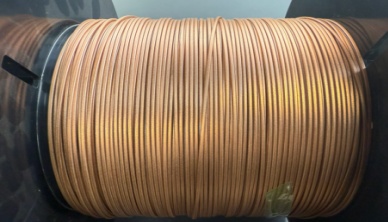
Beyond temperature resistance, ETFE insulated wire is valued for a broader range of performance advantages that make it suitable for demanding applications. While many buyers initially focus on the answer to what is the temperature rating of ETFE wire insulation, they often choose this material for its overall balance of properties rather than heat resistance alone. ETFE offers excellent resistance to many chemicals, oils, fuels, and cleaning agents, which makes it especially useful in industrial, transportation, and harsh-environment applications. It also has strong abrasion resistance, helping protect the conductor in systems exposed to friction, vibration, or repeated handling. In addition, ETFE provides dependable dielectric performance, making it a reliable choice for wiring systems where electrical insulation stability is critical. This supports both signal integrity and overall electrical safety in complex assemblies. Another major benefit is its lightweight, thin-wall construction. ETFE wire insulation can often be manufactured with a reduced wall thickness while still maintaining durability, which is highly valuable in applications where lowering cable bundle size or reducing system weight can improve design efficiency. Because of this combination of mechanical toughness, chemical durability, electrical reliability, and compact design, ETFE performs well in environments involving thermal cycling, repeated movement, and exposure to aggressive substances.
Even when ETFE wire insulation is rated to 150°C, actual service performance depends on how and where the wire is used. This is why selection should always go beyond the headline temperature figure shown in a specification sheet. In practical applications, many external and internal factors can influence whether the wire can continuously perform at its rated level over the long term. Understanding these factors helps engineers and buyers make more accurate decisions when selecting ETFE insulated wire for demanding environments.
If wires are bundled tightly, routed near heat sources, or placed in poorly ventilated areas, heat buildup may be higher than expected. This can cause the insulation to operate closer to its thermal limit, even if the ambient temperature seems acceptable.
Electrical current naturally generates heat. If the conductor carries more current than intended, the wire temperature can rise beyond the insulation’s optimal operating range, which may affect long-term reliability.
Copper, plated copper, and other conductor choices can influence thermal behavior, flexibility, and compatibility with the intended application. A different conductor design may change how efficiently heat is dissipated.
Repeated movement, bending, or vibration can affect long-term insulation life, especially when combined with heat exposure. In dynamic environments, this factor becomes even more important.
Different industries may apply different test standards and approval requirements. The same material may appear in several constructions with different official ratings or certifications.
That is why the best practice is to evaluate ETFE insulated wire based on the complete application environment, not only the nominal maximum temperature.
So, what is the temperature rating of ETFE wire insulation? In most cases, the standard answer is up to 150°C continuous operation, although the exact rating depends on the wire construction and the application standard involved. More importantly, ETFE insulated wire is not defined by temperature alone. It is valued because it combines heat resistance with abrasion resistance, chemical durability, thin-wall efficiency, and reliable electrical insulation. From our perspective as a wire and cable manufacturer, the most effective way to select ETFE wire is to look at the entire operating environment rather than relying on a single performance number. If you are evaluating high-performance wire solutions and want a clearer recommendation based on your actual project conditions, we suggest learning more from Yusheng Electronic Co., Ltd. We believe a practical technical discussion is often the best starting point when choosing the right ETFE insulated wire for long-term reliability.
Yes. ETFE insulated wire is commonly used in high-temperature applications because it is typically rated for continuous operation up to 150°C, while also offering strong mechanical and chemical resistance.
The main difference is performance level. ETFE wire insulation generally offers higher temperature resistance, better abrasion resistance, and stronger chemical durability than PVC, while PVC is usually more economical for general-purpose use.
ETFE insulated wire is widely used in aerospace, automotive systems, industrial equipment, medical devices, and compact electronic assemblies where heat resistance and durability are important.
You should compare operating temperature, voltage, space limitations, mechanical stress, and chemical exposure. If your application needs a tough, thin-wall, high-performance insulation material, ETFE wire may be a strong option.


