
English ![]()

Tel: +86-13732621090
Email:yewu001@yushengdz.com
4F, No.68, Huian Road, Xukou Town, Wuzhong District, Suzhou, Jiangsu, China, 215105
Views: 0 Author: Site Editor Publish Time: 2025-11-25 Origin: Site
Choosing the right conductor is one of the most important decisions in any electrical or power‑electronics design. Whether you are building a high‑frequency transformer, a wireless charging coil, or a simple DC power bus, the wire type you choose directly affects efficiency, heat, size, cost, and long‑term reliability.
Two of the most common options are Litz Wire and Solid Wire. They may look similar at a glance, but they behave very differently under AC, especially at higher frequencies. In this guide, you’ll learn how each works, where each excels, and how to decide which is truly “better” for your specific application.
Every conductor is not created equal. At low frequency or DC, most copper conductors perform similarly: current flows through almost the entire cross‑section of the metal, and losses are easy to predict from basic resistance calculations.
At higher frequencies, however, two electromagnetic effects start to dominate:
Skin effect – current crowds towards the surface of the conductor.
Proximity effect – nearby AC conductors disturb each other’s current distribution.
These phenomena increase AC resistance, generate extra heat, and dramatically reduce efficiency in coils, transformers, and inductors. This is where Litz Wire and Solid Wire diverge in performance.
Key factors that determine which conductor is better in practice include:
Operating frequency range
RMS and peak current
Power‑loss and efficiency targets
Mechanical requirements (flexing, vibration, routing)
Budget and manufacturability
In short, Litz Wire is usually the superior choice for high‑frequency applications, while Solid Wire often wins for DC and low‑frequency systems. The details below will help you make an informed choice.
Solid Wire is exactly what it sounds like: a single, continuous piece of metal, typically copper or aluminum. It may be bare (no insulation) or coated with enamel or plastic insulation, depending on the application.
Because it contains just one homogeneous conductor, Solid Wire is simple, robust, and easy to manufacture. It is the traditional choice for fixed wiring and many low‑frequency power circuits.
At DC and power‑line frequencies, Solid Wire behaves very predictably:
The entire cross‑section of the conductor carries current.
Resistance depends on length, cross‑sectional area, and material resistivity.
For a given gauge, Solid Wire has the lowest DC resistance among common conductor types.
As the frequency increases, however, skin effect becomes significant:
AC current migrates towards the outer surface of the conductor.
The effective conducting area shrinks.
AC resistance rises, sometimes by an order of magnitude or more at high frequency.
This makes Solid Wire increasingly inefficient in high‑frequency coils and transformers, particularly when the wire diameter is much larger than the skin depth at the operating frequency.
Solid Wire has mechanical advantages in many installations:
High tensile strength for a given cross‑section
Holds its shape once bent, useful for fixed routing
Easy to strip, crimp, and solder
However, the same rigidity that helps in fixed wiring can be a drawback when movement or vibration is present:
Limited flexibility – repeated bending can cause fatigue and breakage
Not ideal for dynamic harnesses, robotic arms, or moving machinery
Solid Wire is widely used wherever conductors are mostly stationary and frequencies are low, for example:
Residential and commercial building wiring
Fixed power distribution inside equipment
Low‑frequency (50/60 Hz) transformer primaries and secondaries
PCB jumpers and point‑to‑point connections in static assemblies
In these contexts, the skin effect is negligible, and Solid Wire offers an excellent balance of low resistance, mechanical strength, and low cost.
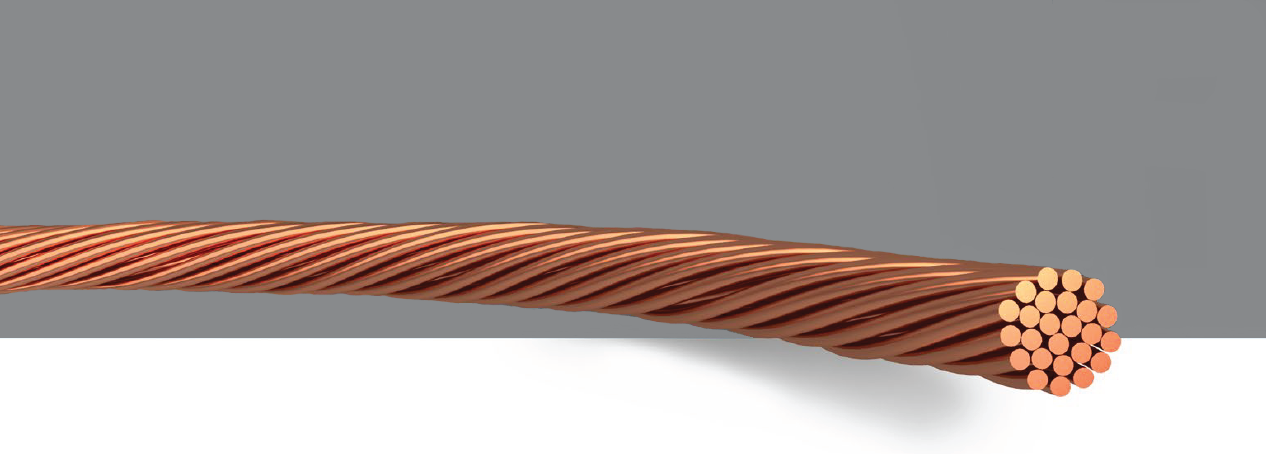
Litz Wire (from the German “Litzendraht,” meaning braided or stranded wire) is engineered specifically to reduce high‑frequency AC losses. Unlike conventional stranded cable, Litz Wire consists of:
Many fine copper strands
Each strand individually insulated (often with enamel)
Strands twisted or woven together in carefully controlled patterns
These patterns may involve multiple levels of bundling. For example, small groups of strands are twisted together, then those groups are twisted into larger bundles, and so on. The geometry is designed so that each strand periodically moves from the interior to the exterior of the bundle along its length.
The main goal of Litz Wire is to keep AC resistance as close as possible to DC resistance across a defined frequency range.
It does this in two fundamental ways:
Strand diameter below skin depth
Each individual strand is thin—often much thinner than the skin depth at the design frequency. That means current can flow through almost the entire cross‑section of each strand, rather than being restricted to an outer skin.
Equal exposure to the magnetic field
Because the strands are twisted and transposed, each one spends comparable time near the outside and inside of the bundle. This prevents any single strand from being permanently “buried” in a high‑loss region. The result is:
More uniform current distribution among strands
Strong reduction of both skin effect and proximity effect
Substantially lower AC resistance than an equivalent‑area Solid Wire at high frequency
Litz Wire is most effective in the frequency range where skin and proximity effects are strong but before parasitic capacitances start to dominate:
Highly beneficial from roughly 10 kHz up to a few hundred kHz
Often used successfully up to about 500 kHz
Beyond around 1–2 MHz, increased inter‑strand capacitance and other parasitics can erode many of the benefits
At lower frequencies, the advantage of Litz Wire over properly sized solid or conventional stranded conductors is smaller, and cost considerations tend to favor simpler options.
Because Litz Wire minimizes AC losses, it is the conductor of choice for many high‑frequency and high‑efficiency systems, including:
High‑frequency transformers and inductors in switch‑mode power supplies
Inductive charging systems (consumer wireless chargers, EV pads, medical implants)
Induction heating and induction cookers
High‑Q coils in radio transmitters and receivers at low to medium RF
Precision timing and low‑frequency RF broadcast coils where low loss is critical
Whenever your design involves significant AC current above roughly 10 kHz and you need high efficiency, low heat, or compact magnetics, Litz Wire is usually the superior solution.
To understand why Litz Wire and Solid Wire behave so differently, it helps to revisit the two key phenomena:
Skin effect – At higher frequencies, AC current flows mainly in a thin region near the conductor surface. The deeper inside the conductor, the lower the current density. The thickness of this layer is the skin depth, which decreases with frequency. When wire diameter greatly exceeds skin depth, much of the copper carries little or no current, effectively wasting material and raising resistance.
Proximity effect – When conductors carrying AC current are near each other, their magnetic fields interact. This interaction pushes current into narrow regions on each conductor (e.g., the sides facing or facing away from neighbors), further increasing AC resistance beyond what skin effect alone would cause.
Both effects grow with frequency and with the size and layout of conductors. In tightly wound coils and transformers, they can dominate total copper losses.
For Solid Wire:
DC resistance is minimal for a given gauge and length.
AC resistance rises sharply as frequency increases, especially for larger diameters and packed windings.
At high frequency, Rac can be many times Rdc, causing significant I²R heating.
For Litz Wire:
DC resistance is slightly higher than an ideal solid conductor of the same copper cross‑section, due to:
Extra strand length from twisting (lay length, “take‑up”)
Small gaps between insulated strands
AC resistance, however, remains much closer to DC resistance over the design frequency band, because each thin strand operates with minimal skin‑effect loss and reduced proximity effect.
The net result: in high‑frequency magnetics, Litz Wire often delivers much lower AC loss than Solid Wire, even if its DC resistance is marginally higher.
In high‑frequency applications, the reduction in AC resistance directly translates to:
Lower copper losses
Lower operating temperatures
Higher efficiency
Potentially smaller core and winding size (because you can dissipate less heat)
A Solid Wire winding may appear cheaper initially, but the extra loss and thermal stress can force you to use a larger core, more copper, or additional cooling—costs that quickly erode any savings.
By contrast, a well‑designed Litz Wire winding allows you to:
Achieve high efficiency in a smaller magnetic component
Meet stringent energy‑efficiency regulations
Improve reliability by reducing thermal stress on insulation and cores
From a practical standpoint, both conductors have distinct mechanical behaviors:
Solid Wire
Stiff and shape‑retaining
High tensile strength
Easy to strip and terminate
Poor flex life under repeated bending
Litz Wire
Very flexible because it uses many fine strands
Well suited to coils with many turns and small bending radii
Better resistance to fatigue in vibrating environments
Requires more care to terminate correctly: enamel must be removed from each strand or burned off using appropriate thermal or chemical processes, and correct soldering or crimping is essential to connect all strands reliably
Cost is often the main argument against Litz Wire:
Solid Wire
Lowest material and processing cost
Simple supply chain and straightforward assembly
Ideal for high‑volume, cost‑sensitive, low‑frequency products
Litz Wire
Many fine strands
Individual insulation
Controlled braiding and cabling operations
Higher material cost due to:
Assembly time and tooling may be higher, particularly at terminations
However, in many high‑frequency designs, the “real” cost is not just the conductor. When you include:
Higher energy losses
Extra cooling
Oversized magnetic cores
Reduced reliability due to temperature rise
Litz Wire frequently offers better total cost of ownership over the life of the product.
To decide whether Litz Wire or Solid Wire is better, start with these questions:
What is the operating frequency (including harmonics)?
What are RMS and peak currents?
How much copper loss and temperature rise can the design tolerate?
Is the conductor fixed or moving? Is vibration significant?
What are the space, weight, and cost constraints?
Are there regulatory or efficiency standards to meet?
Your answers determine which conductor type makes more sense.
Choose Solid Wire when:
The application is DC or low frequency, such as:
0 Hz (DC) to power‑line 50/60 Hz
Low audio frequencies where wire diameter is small relative to skin depth
Conductors are mostly stationary and not subject to ongoing flexing
The priority is low initial cost and simple assembly
Efficiency and heat generation are acceptable with conventional design margins
Examples:
Building electrics and distribution boards
Internal wiring of many household appliances
Low‑frequency transformers and chokes
Grounding and bonding conductors
In these cases, the extra sophistication and cost of Litz Wire are often unnecessary.
Litz Wire becomes the clear winner when:
Operating frequency is typically above about 10 kHz and often up to a few hundred kHz
The design includes inductors, transformers, or coils with significant AC current
Efficiency and low copper loss are crucial to meeting performance or regulatory targets
Space and thermal budgets are tight, and smaller, cooler magnetics are desired
Examples:
Switch‑mode power supplies (SMPS) inverters and converters
Wireless power transfer systems and charging pads
Induction heating and induction cooking systems
High‑Q RF coils for communication and precision timing
Compact, high‑power medical or industrial magnetics
In these applications, the performance gains from Litz Wire often justify the added cost and complexity.
Some designs benefit from a combination of conductors or from intermediate solutions:
Using standard stranded wire (without individual strand insulation) in mid‑frequency, moderate‑loss applications where some improvement is needed but full Litz is not economical.
Combining Solid Wire windings and Litz Wire windings within the same transformer, optimized per winding frequency and function.
Implementing parallel smaller solid conductors rather than a single large one, as a partial mitigation of skin effect, while still not achieving the full benefits of Litz Wire.
In borderline cases, calculation or simulation of AC resistance and copper loss is essential to justify the choice.
Across manufacturers, engineering blogs, and technical communities, there is strong consensus on when each conductor type is appropriate.
One major magnet wire manufacturer emphasizes that Solid Wire is the most cost‑effective choice for stationary DC and 50/60 Hz installations, while Litz Wire is described as a specialized but highly effective solution for high‑frequency systems where skin and proximity effects must be minimized.
A high‑end wire and cable producer focusing on Litz Wire provides detailed design guidance: engineers are encouraged to start from the operating frequency and RMS current, select strand gauge accordingly, and then calculate both DC and AC resistance. Their worked examples show that a carefully designed Litz construction can have an AC resistance only slightly above its DC resistance, while an equivalent‑area Solid Wire can suffer AC resistance more than an order of magnitude higher at the same frequency.
An engineering tech blog simplifies the concepts for practitioners: Solid Wire is praised for DC and low‑frequency use, but criticized for wasting interior copper at higher frequencies. The author notes that simple multi‑stranded cable, without strand insulation, behaves much like a single solid conductor under high‑frequency AC, so it cannot match Litz Wire’s performance. Litz Wire is recommended for high‑frequency transformers, inductors, induction coils, and switching power supplies despite its higher price.
Reference materials and encyclopedic sources on Litz Wire underline its use in high‑Q inductors, induction heating, and wireless power. They highlight that Litz Wire is particularly effective below roughly 500 kHz and less useful above a few megahertz because parasitic capacitance between strands becomes dominant.
Engineering editorial content comparing Litz Wire vs. Solid Wire emphasizes the main trade‑off: Litz Wire offers significantly lower AC resistance and better current distribution at high frequency, with excellent flexibility, while Solid Wire provides lower DC resistance per cross‑section, simpler construction, and stronger mechanical properties under static conditions. The editorial consensus is that Solid Wire is best for low‑frequency or static wiring, and Litz Wire is best when high‑frequency efficiency is a primary design objective.
High‑frequency magnetics design notes from power‑electronics specialists point out that Litz Wire must be engineered, not just selected: strand size, strand count, lay length, and bundling pattern must match frequency, current waveforms, and core geometry. They caution that poorly chosen Litz constructions may not deliver the expected gains, but also show that correctly designed Litz Wire can dramatically reduce winding losses and enable much higher power density than Solid Wire windings.
Together, these viewpoints reinforce the practical rule: Solid Wire for simple, low‑frequency, cost‑driven systems; Litz Wire for demanding high‑frequency, high‑efficiency magnetics.
Use this checklist to decide whether Litz Wire or Solid Wire is better for your design:
Define electrical conditions
Operating frequency and its harmonics
RMS and peak currents
Voltage and insulation requirements
Quantify performance targets
Maximum allowable copper loss (W)
Target efficiency (%)
Acceptable temperature rise
Assess mechanical and environmental needs
Is the conductor fixed, flexing, or vibrating?
Required bend radius and routing complexity
Ambient temperature and cooling strategy
Evaluate constraints
Available space and allowable winding window fill
Weight limits (e.g., aerospace, portable devices)
Material and assembly budget
Compare options
Calculate or estimate DC and AC resistance for Solid Wire
Do the same for an appropriate Litz Wire construction
Include transformer or inductor core losses in the total loss budget
Decide on conductor type
If frequency is low and losses are acceptable → Solid Wire is usually sufficient.
If high‑frequency AC losses dominate and efficiency or size is critical → Litz Wire is usually the superior choice.
Refine the Litz design if chosen
Select strand gauge so strand diameter is compatible with skin depth at your frequency
Determine strand count to handle RMS current with acceptable temperature rise
Choose suitable insulation and outer jacket for the environment
Plan proper stripping, soldering, or crimping methods to connect all strands reliably
Following this structured process will help avoid both over‑engineering and under‑engineering your conductors.
What is Litz Wire in simple terms?
Litz Wire is a special type of cable made from many very thin, individually insulated copper strands woven together. It is designed to reduce high‑frequency AC losses by ensuring current can flow through the full cross‑section of each strand instead of just the outer skin of a thick conductor.
When does Litz Wire outperform Solid Wire?
Litz Wire outperforms Solid Wire when the operating frequency is high enough that skin and proximity effects significantly increase AC resistance—for example, in high‑frequency transformers, inductors, wireless charging coils, and induction heating systems.
Is Litz Wire always more efficient than Solid Wire?
No. At DC and low frequencies where skin effect is negligible, a properly sized Solid Wire can be just as efficient or even slightly better from a pure DC resistance standpoint. Litz Wire shows its advantage once AC losses become a dominant factor.
Can I simply replace all Solid Wire in my system with Litz Wire?
Technically you can, but it is rarely necessary or cost‑effective. Use Litz Wire only where high‑frequency AC currents are present and reduced loss or higher efficiency will offset the added material and assembly cost.
Up to what frequency is Litz Wire beneficial?
Litz Wire is most beneficial from roughly tens of kilohertz up to a few hundred kilohertz, and often still valuable up to around 500 kHz or so. Above a few megahertz, parasitic capacitances and other effects reduce its performance advantage.
How do I choose strand size and count for Litz Wire?
Strand diameter should be similar to or smaller than the skin depth at your operating frequency. Strand count is chosen based on the total cross‑section needed to carry your RMS current with acceptable temperature rise. Many manufacturers provide design assistance and tables to streamline this process.
Are there special techniques for terminating Litz Wire?
Yes. Because each strand is insulated, you must remove the enamel or film from all strands in the bundle at the termination point. This can be done via solder‑pot tinning, thermal stripping, chemical stripping, or mechanical methods, followed by proper soldering or crimping to ensure every strand is electrically connected.
So, is Litz Wire better than Solid Wire? The honest answer is: it depends on what you are building.
Choose Solid Wire when:
Your system operates at DC or low frequency
Conductors are static and straightforward to route
Low initial cost and simple assembly are your top priorities
Choose Litz Wire when:
Your application involves high‑frequency AC, typically above about 10 kHz
Efficiency, low heat, and compact magnetics are critical
You want to minimize skin‑ and proximity‑effect losses in coils, transformers, or inductors
In modern power electronics, wireless power, and RF systems, Litz Wire is often the key to achieving high efficiency and power density. In conventional building wiring and low‑frequency power distribution, Solid Wire remains the most practical and economical choice.
By carefully analyzing your electrical, mechanical, and cost requirements—and by understanding how Litz Wire and Solid Wire behave under real operating conditions—you can select the conductor that is truly “better” for your design, not just on paper, but in long‑term performance and reliability.


