
English ![]()

Tel: +86-13732621090
Email:yewu001@yushengdz.com
4F, No.68, Huian Road, Xukou Town, Wuzhong District, Suzhou, Jiangsu, China, 215105
Views: 0 Author: Site Editor Publish Time: 2026-04-14 Origin: Site
In the oil and gas industry, wire performance is never a minor detail. Electrical systems operate inside some of the most punishing environments in modern industry, where heat, pressure, chemicals, vibration, and constant mechanical stress can quickly expose the weaknesses of conventional insulation materials. From downhole tools and drilling equipment to sensors, motors, and control systems, the reliability of a single insulated wire can directly affect uptime, safety, maintenance frequency, and equipment lifespan. That is why material selection matters so much. At our company, we have seen that when engineers move beyond standard insulation and choose advanced materials designed for extreme service conditions, they gain a measurable advantage in operational stability. Among these advanced materials, PEEK insulated wire stands out as one of the most effective options for demanding oil and gas applications.
PEEK, or polyether ether ketone, is known for its outstanding thermal, mechanical, and chemical resistance. When used as wire insulation, it helps electrical components maintain integrity even under severe operating conditions that would damage many traditional materials. In oil and gas settings, where equipment is often deployed in remote or high-risk environments, this matters not only for performance but also for cost control and system confidence.
Oil and gas environments place extraordinary demands on electrical wiring systems. Insulated wire may be exposed to:
· high and fluctuating temperatures
· aggressive chemicals and hydrocarbons
· abrasive contact and mechanical wear
· vibration and bending stress
· confined spaces with strict reliability requirements
In such conditions, insulation failure can lead to signal loss, short circuits, reduced efficiency, or complete equipment shutdown. For offshore platforms, drilling systems, logging tools, and refinery control equipment, even a small wiring failure can create expensive maintenance delays.
This is why material selection should never be based on initial cost alone. A lower-cost wire may seem attractive during procurement, but if it degrades too quickly in the field, the total lifecycle cost becomes much higher. PEEK insulated wire is often chosen because it supports a more stable and durable system over time.
PEEK is a high-performance thermoplastic engineered for extreme service environments. Compared with common insulation materials, it offers a more balanced combination of heat resistance, dielectric performance, mechanical toughness, and chemical stability.
Excellent thermal endurance
PEEK can maintain performance at high continuous operating temperatures, making it suitable for systems located near heat-generating equipment or deployed deep underground.
Strong chemical resistance
Oil and gas operations involve prolonged exposure to fuels, lubricants, drilling fluids, solvents, and corrosive substances. PEEK resists many of these chemicals without significant breakdown.
Mechanical durability
In applications where wires may be bent, pulled, or exposed to friction, PEEK provides robust insulation that helps reduce cracking and wear.
Dimensional stability
PEEK maintains its shape and properties under stress, which is important when wire routing is tight and space is limited.
Long service life
Because of its resistance to environmental and operational damage, PEEK insulated wire can contribute to fewer replacements and lower maintenance demands.
High temperature is one of the most persistent challenges in oil and gas applications. Downhole exploration, drilling systems, and certain refinery operations can expose wire insulation to temperatures that exceed the safe range of standard materials. Once insulation softens, becomes brittle, or begins to degrade, system reliability drops quickly.
PEEK insulated wire enhances performance by maintaining electrical insulation integrity under high heat. This is especially valuable for sensor wiring, instrumentation leads, and power transmission lines placed close to engines, pumps, turbines, or subsurface equipment. Stable insulation under heat helps preserve consistent signal quality and reduces the risk of thermal failure.
Another advantage is temperature cycling resistance. In real operating conditions, wires are not only subjected to high temperatures but also repeated heating and cooling. These cycles can weaken less advanced materials over time. PEEK performs well under repeated thermal stress, helping support longer operational life.
Oil and gas systems rarely operate in clean and controlled environments. Wires may come into contact with drilling mud, hydraulic fluids, fuels, production chemicals, salt spray, cleaning agents, and other corrosive substances. If the insulation material absorbs, swells, cracks, or erodes, overall system performance is compromised.
PEEK insulated wire is valued because it resists a broad range of chemicals that are common in oil and gas settings. This allows it to perform reliably in applications such as:
These tools often work in harsh chemical and thermal conditions where insulation failure is difficult and expensive to repair.
Salt-laden air, moisture, and chemical exposure demand a wire insulation material with excellent environmental resistance.
Process control systems depend on accurate signal transmission, which requires insulation that remains stable around aggressive process media.
Electrical components near fluid-handling systems need wiring that can withstand both heat and chemical splashes.
When wire insulation remains stable in these environments, operators gain better confidence in both safety and performance consistency.
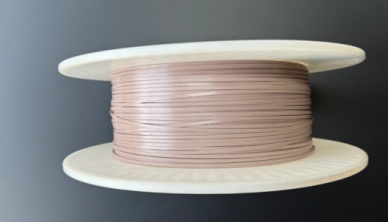
Oil and gas equipment is not static. Machinery vibrates, drilling strings move, tools are inserted and retrieved, and cables may be routed through compact or abrasive pathways. In these applications, insulation must do more than resist heat and chemicals. It must also survive physical stress.
PEEK insulated wire offers high mechanical strength, which helps prevent damage caused by abrasion, repeated flexing, compression, and impact. This makes it particularly useful in moving systems or equipment with ongoing vibration.
The benefit is not only durability but also reliability of signal and power continuity. If insulation cracks or wears through, electrical faults become much more likely. By reducing mechanical degradation, PEEK supports better long-term equipment performance in field conditions where access is limited and downtime is costly.
The table below shows how PEEK insulated wire is typically evaluated against general-purpose insulation materials in harsh oil and gas environments.
Performance Factor | General-Purpose Insulation | PEEK Insulated Wire |
High temperature resistance | Moderate to low | Excellent |
Chemical resistance | Varies widely | Excellent |
Abrasion resistance | Moderate | High |
Dimensional stability | Moderate | High |
Long-term reliability in harsh environments | Limited | Strong |
Suitability for critical oil and gas systems | Often application-limited | Highly suitable |
This comparison helps explain why PEEK insulated wire is often selected for mission-critical applications rather than standard-duty wiring tasks.
Not every wire application requires premium insulation. However, in oil and gas, there are several scenarios where using PEEK provides clear value.
Temperature and pressure sensors need stable, reliable wiring in extreme underground conditions.
Signal integrity is essential. PEEK helps protect sensitive wiring from temperature, fluid exposure, and mechanical damage.
Control wiring in these systems benefits from insulation that resists chemical contact and repeated operational stress.
Marine and industrial exposure creates an environment where robust insulation directly supports maintenance reduction.
PEEK insulated wire performs well where process heat and chemical resistance are both essential.
In our experience, the greatest return comes when PEEK is used in applications where failure is expensive, access is difficult, or operational continuity is critical.
When we look at the full picture of oil and gas operations, it becomes clear that wire insulation is not just a secondary specification. It is a foundational part of system reliability. PEEK insulated wire enhances performance in oil and gas applications by helping electrical systems withstand high temperature, chemical exposure, vibration, abrasion, and long-term mechanical stress. These benefits are especially important in critical environments where repair is difficult, downtime is costly, and stable performance is essential. From downhole tools to offshore systems and refinery instrumentation, PEEK offers a practical solution for demanding conditions where conventional insulation materials may fall short.
At Yusheng Electronic Co., Ltd., we believe material performance should be aligned with real operating needs rather than basic specification matching alone. For companies evaluating high-performance wire solutions for harsh industrial environments, PEEK insulated wire is worth serious consideration as part of a long-term reliability strategy. If you would like to understand which wire structure or insulation configuration best fits your oil and gas application, you can contact Yusheng Electronic Co., Ltd. for more information and technical discussion.
PEEK insulated wire is suitable because it combines high temperature resistance, chemical resistance, mechanical toughness, and long-term electrical stability, all of which are important in harsh oil and gas environments.
Yes. It is commonly considered for downhole tools because these applications require insulation that can withstand extreme heat, pressure-related stress, and chemical exposure while maintaining performance.
In harsh environments, it often performs better than standard insulation materials because it is designed for demanding operating conditions where ordinary materials may degrade more quickly.
Buyers should evaluate operating temperature, chemical exposure, mechanical stress, conductor requirements, insulation thickness, flexibility needs, and the manufacturing quality of the wire supplier.


